NX-OS 10.2: Multicast NAT Overview
7:27
Learn about Multicast Service Reflection on the Nexus 9000 and how bringing this capability within the network itself will improve network performance and scale.
Related Videos
In Data Center Fabrics
-
Play video Seamless Kubernetes Connectivity: Isovalent Private Networks over VXLAN EVPN
Seamless Kubernetes Connectivity: Isovalent Private Networks over VXLAN EVPN
Integrate K8s and Cisco NX-OS via VXLAN EVPN. Extend cloud-native networking to virtualized workloads, use a distributed routing model without central gateways, and maintain end-to-end policy consistency with SGTs that scale with your workloads.
10:05
-
Play video VXLAN EVPN to the Rescue!
VXLAN EVPN to the Rescue!
Define the fundamentals of VXLAN EVPN and how they fit together. Learn the of history of how VXLAN EVPN came about, and what problems it solves.
4:25
-
Play video Bill Gartner discusses Cisco innovations for data center speed migrations
Bill Gartner discusses Cisco innovations for data center speed migrations
Cisco enables customers to evolve their data centers using existing infrastructure with innovations like 400G BiDi.
1:38
-
Play video NX-OS 10.2: EVPN Distributed NAT Overview
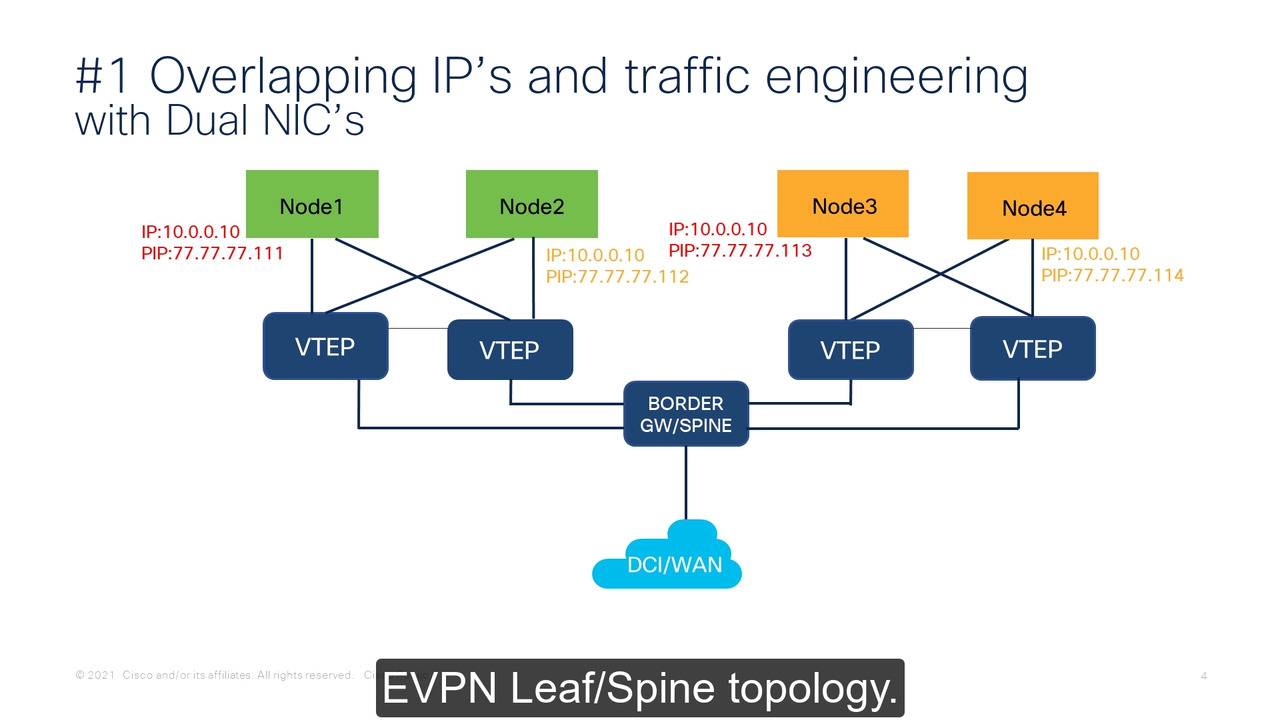
NX-OS 10.2: EVPN Distributed NAT Overview
EVPN Distributed NAT enables Network Address Translation in a VXLAN EVPN fabric and offers enhancements like mobility and traffic engineering at host level and on border nodes for DCI (Data Center Interconnect).
9:20
-
Play video NX-OS 10.2: Inter-VRF and Multi-site Service Chaining Overview
NX-OS 10.2: Inter-VRF and Multi-site Service Chaining Overview
Learn about ePBR enhancements on Inter-VRF service chaining and multi-site support introduced in NX-OS 10.2 and use cases now available with this new capability.
9:43
-
Play video Unifying Kubernetes and Data Centers: End-to-End Visibility with Isovalent and Cisco Nexus One
Unifying Kubernetes and Data Centers: End-to-End Visibility with Isovalent and Cisco Nexus One
Integrate Isovalent Cilium Timescape with Cisco Nexus One for a single, coherent view across K8s clusters and fabric. Eliminate blind spots, troubleshoot with confidence, and accelerate MTTR.
9:34